Fixtureless Assembly Planning
Imagine building a lego set: You get an instruction booklet that tells ou the order in which you need to assemble the parts that you got, but it does not tell you how to grasp a piece, or how to bring the pieces to the desired goal location in the required orientation, or how to apply the force needed. In this example, we often use our hands, or the table as support of a sub-assembly for the forces of pushing parts together: We do not have a specific fixture in which we place the objects for assembly.
Informally, this is what we are trying to get robots to do. However, robots without dexterous hands are severly limited in how they can reorient objects, and thus need to do it via handovers, or repeatedly setting the objects down, and regrasping.
We formulate this problem as a search-problem where we try to find the multi-robot sequence that achieves the full assembly at its end. In this search problem, we need to figure out how to balance the forces that are happening in the assembly steps, we need to deal with the branching of the search from the many pick and place transformations, and we need to find a motion plan at the end.
To achieve this, Wʀᴀᴘ combines:
- lazy milestone-based task planning guided by a backwards abstraction,
- mechanics-aware reasoning about grasps, table contacts, cooperative holding, and bracing, and
- joint keyframe selection, collision-free motion planning, and execution retiming.
We give a brief description of parts of the system below:
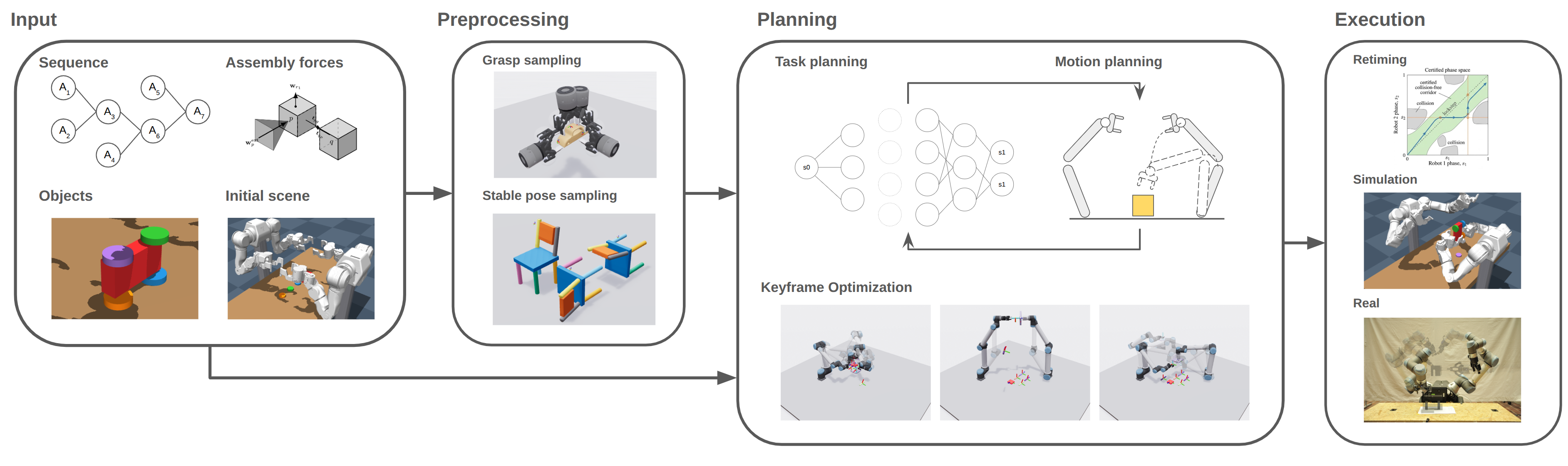
Search
The core idea of the search is that we want to leverage information from assembly, and from disassembly of the object. First, in the high level loop, we choose one of the possible next steps from the inter-part dependencies that we are given.
We then try to find a feasible robot action sequence to fulfill this one goal. The actions we are considering are pick, place, handover, add_grasp, remove_grasp, and assemble. We also support a 'reorient' action, but do not use that in this work.
Backward Search
In the backward search, we compute a heuristic that we use in the forward search. We do that by running a search from all possible goal states that have the parts that we want to assemble in this current search. The search proceeds by applying the actions backwards, i.e. 'pick' becomes 'place', 'handover' stays 'handover', but the direction changes, etc.
We do not blindly just apply the backwards actions, but we do some filtering with cheap validity checks:
- Wrench feasibility: We check if the forces that arise in an assembly check (and in any other action) by formulating a linear program for all parts in the currently considered subassembly. This LP tells us if the robots can support the external forces.
\begin{equation} \label{eq:per_part_eq} \sum_{i\in\mathcal{R}(p)\cup \{\text{table}\}}\mathbf{w}_i + \sum_{q\in\mathcal{N}(p)}\mathbf{t}_{qp} + \mathbf{w}^{\mathrm{ext}}_p = \mathbf{0}, \quad \forall p\in\mathcal{P}, \end{equation} \begin{equation} \label{eq:wrench-feasibility} \begin{aligned} \exists \quad & \mathbf{w}_\text{table}, \{\mathbf{w}_r\}_{r\in\mathcal{R}}, \{\mathbf{t}_{pq}\}_{(p,q)\in\mathcal{E}} \\ \text{s.t.} \quad & \eqref{eq:per_part_eq},\\ & \mathbf{w}_r \in \mathcal{W}_r, \ \ \ \ \forall r\in\mathcal{R}, \ \ \ \ \ \ \mathbf{w}_t \in \mathcal{W}_\text{table}, \\& \mathbf{t}_{pq} \in \mathcal{T}_{p,q}, \ \ \ \forall (p,q)\in\mathcal{E}, \end{aligned} \end{equation}where what each variable means can be seen in the illustration:
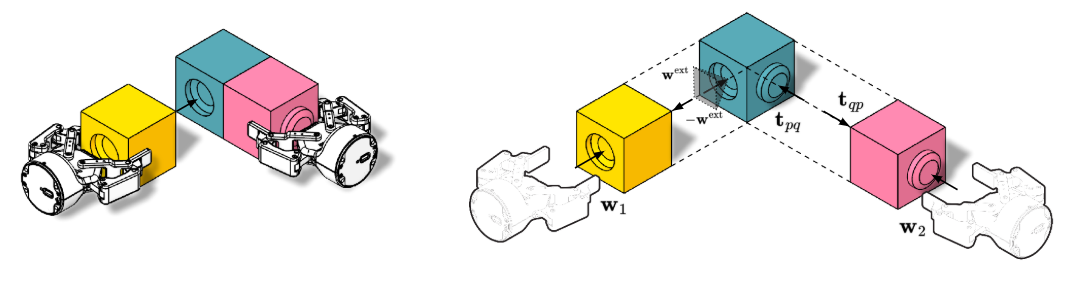
- End effector collision checking: We place floating end effectors at the desired grasp transformation and check if they are collision free.
Forward Search
In the forward search, we leverage the heuristic that we computed in the backward search. Here, we check if we can actually satisfy the constraints that the actions impose, e.g., grasping an object with a robot in a specific way, or handing an object over betweeen two robots.
We do this using an optimization based solver, which we initialize with an analytic solution whenever possible.
Motion Planning & Execution
Once a valid task sequence was found, we first co-optimize all robot configurations using dynamic programming, and then compute a motion plan for our multi-goal, multi-robot, multi-mode planning problem using a bidirectional RRT. We retime this to make the plan dynamically feasible for the robots, and insert the controllers for the manipulation steps and then run it either in simulation, or on the real robot system.